


What are MyHealth@EU services?
In the event of a medical emergency while travelling abroad, doctors can provide better care if they have access to the patient's medical history.
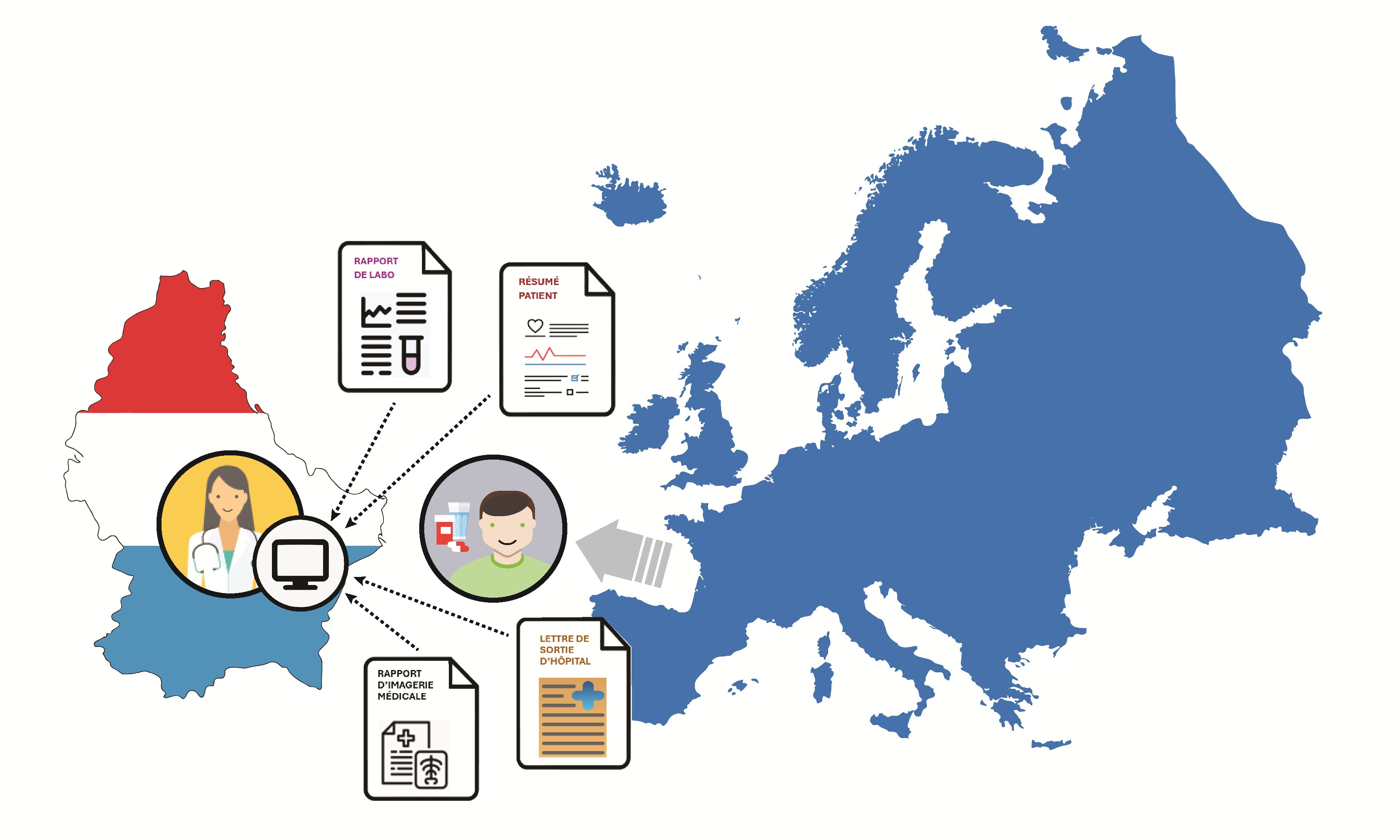
That is why European Union countries are setting up MyHealth@EU, cross-border online health services that enable personal health data to be securely transmitted to doctors in the country where the patient is being treated.
Benefits for patients and doctors
- MyHealth@EU services improve patient care.
- They facilitate the continuity of safe, high-quality care across European borders.
- Medical data is available in the language of the treating doctor's country, removing potential language barriers.

Services available in Luxembourg
► I am a patient registered in Luxembourg
The following documents can be sent to a doctor in another European country*:
- patient summary
- lab results
- medical imaging report
- hospital discharge letter
How can I benefit from this ?
I register my consent for cross-border exchange in my electronic healthcare record (Dossier de Soins Partagé - DSP). This allows doctors in other European countries to consult my documents.
*Cyprus, Estonia, Spain, France, Greece, Ireland, Malta, the Netherlands, Portugal and the Czech Republic
► I am a patient from another European country
A doctor in Luxembourg can receive:
- the patient summary
- the lab results
- the medical imaging report
- the hospital discharge letter
of a patient from another European country.*
How can I benefit from this ?
I have given my consent for cross-border exchange in the healthcare system of my country of affiliation. The doctor in Luxembourg will inform me of my rights – they will do so based on the Patient Information Notice available at the bottom of the page. (See ‘Useful links’)
*Croatia, Cyprus, Estonia, Spain, Malta, Portugal and the Czech Republic
Upcoming services
MyHealth@EU services are being gradually rolled out across Europe. They will become mandatory in all European countries from 2029, as part of the implementation of the European Health Data Space (EHDS).
This project is funded by the European Union. Views and opinions expressed are however those of the author(s) only and do not necessarily reflect those of the European Union or HaDEA. Neither the European Union nor the granting authority can be held responsible for them.